
Zizia. (21-XII-2025). Bombus. Zizia.
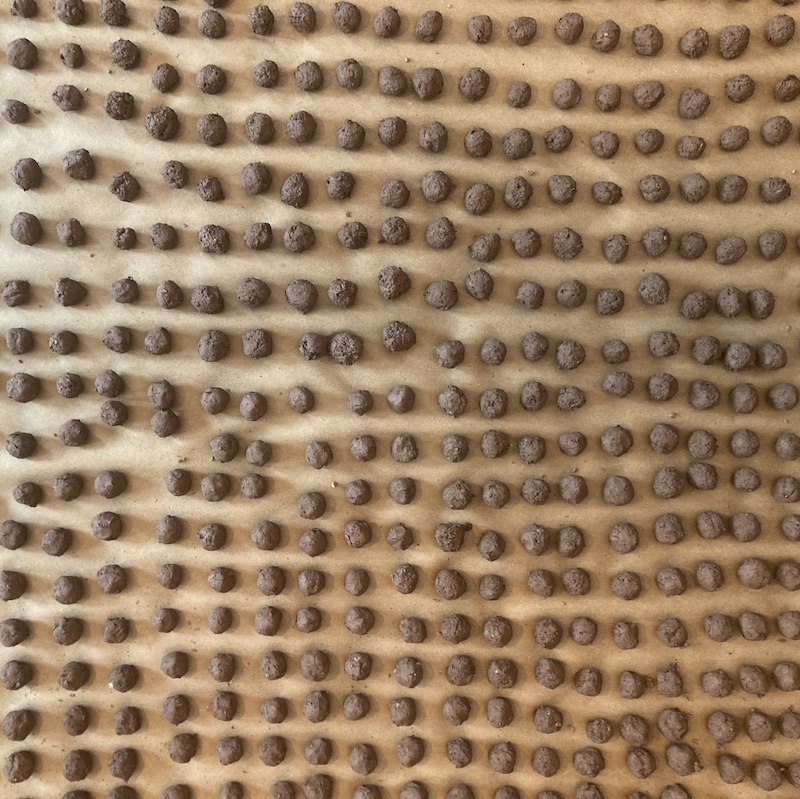
Seed bombs, earth balls, clay dumplings, or nendo dango (粘土団子) are rolled spheres of clay, compost, and seed. Seed bombing is an ancient practice of no-till plant propagation and modern method of guerrilla gardening. Bombing is effective at reducing soil compaction and erosion while introducing plants into harsh environments.Habitat restoration is a vital part of the Zizia creative process*. Zizia has conducted seed bomb workshops in California (2018), Massachusetts (2021, 2023, 2024), and Vermont (2023). Thousands of native wildflower seed bombs have been sown by Zizia across the United States (2019). Zizia seed bombs bloom to feed buzzing bugs and bring beauty to communities.
Methods
Seed bombs should be sown from late fall to early spring. Sow in sites with full sun, low disturbance risk, and weak plant cover. Place and gently press one bomb per square foot into bare soil, gravel, or mulch. Bombs will dissolve and germinate with 3–5” of water. Provide deep and infrequent watering for 1–3 years. Establishment will vary according to location.
- Mix 1–3 parts fine compost and one part seed
- Gradually incorporate five parts air-dry red clay powder
- Gently add water until malleable: Avoid water-logging
- Roll seed bombs to 0.5–1.0 inch diameter spheres
- Dry bombs in sunshine for 24–48 hrs to prevent mold
- Store seed bombs in cool, dry, and ventilated conditions until sown
Species
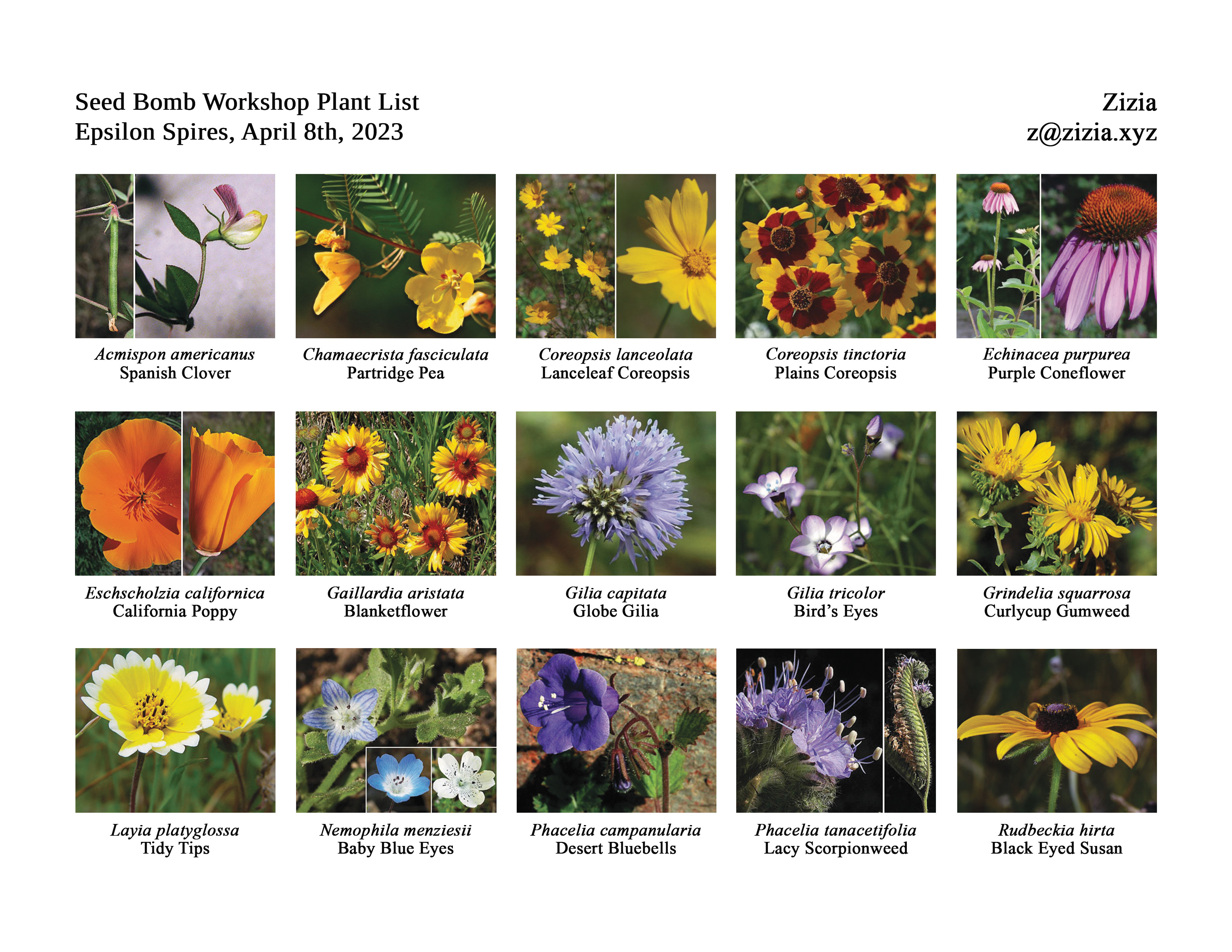
Zizia seed bombs are composed of annual and perennial wildflowers who are native to the United States. Wildflowers that feed native pollinators, particularly Bumble Bees (Bombus spp.), are prioritized. The following species are drought-tolerant, grow in gravelly or sandy soil, prefer full sun (≥ 6 hrs/day), and share benefits, including cut flowers, dyes, and medicines:
- Acmispon americanus, Spanish Clover
- Asclepias tuberosa, Butterfly Milkweed
- Baptisia australis, Blue Wild Indigo
- Baptisia tinctoria, Yellow Wild Indigo
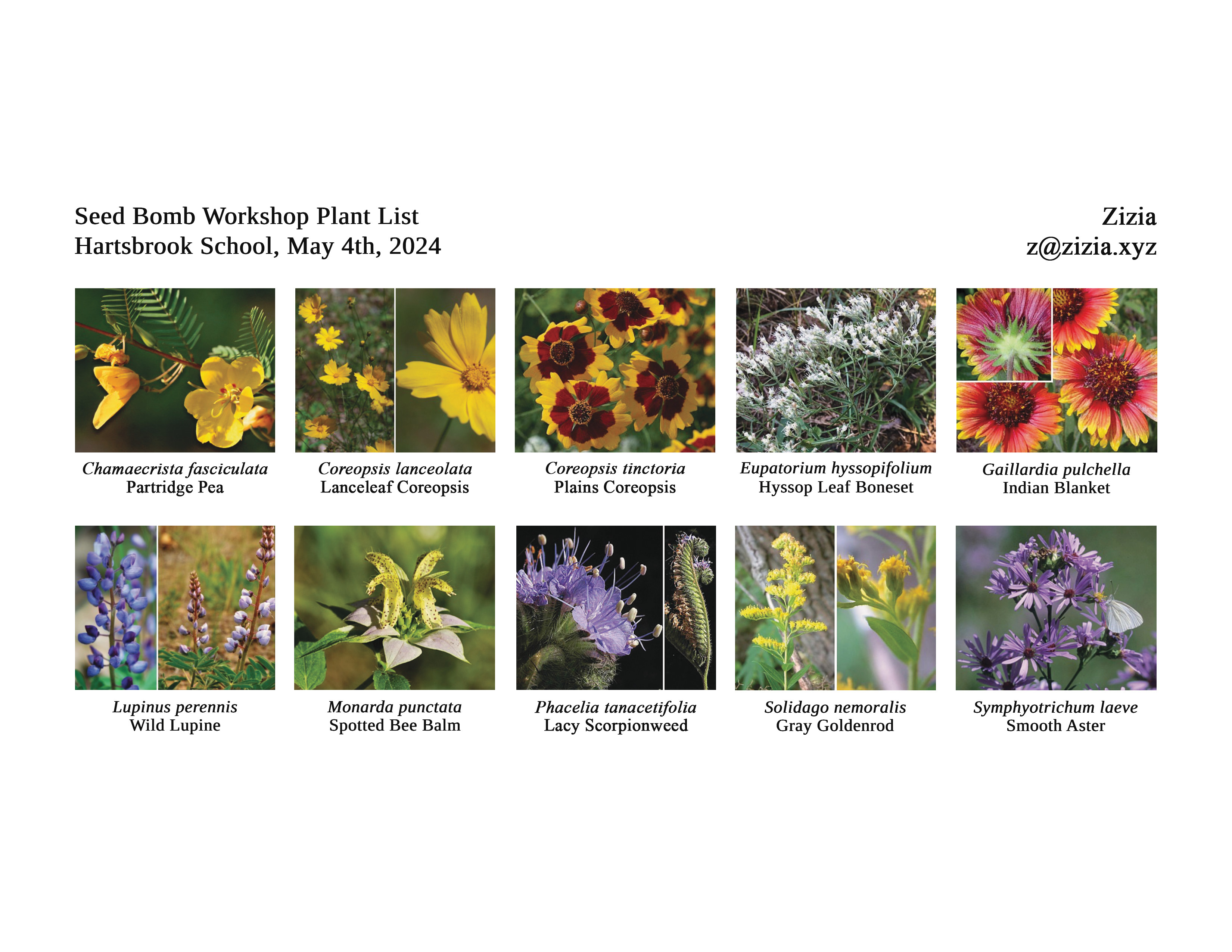
- Chamaecrista fasciculata, Partridge Pea
- Coreopsis lanceolata, Lanceleaf Coreopsis
- Coreopsis tinctoria, Plains Coreopsis
- Echinacea purpurea, Purple Coneflower
- Eschscholzia californica, California Poppy
- Eupatorium hyssopifolium, Hyssop Leaf Boneset
- Euthamia graminifolia, Grass Leaved Goldenrod
- Gaillardia aristata, Blanketflower
- Gaillardia pulchella, Indian Blanket
- Gilia capitata, Globe Gilia
- Gilia tricolor, Bird’s Eyes
- Grindelia squarrosa, Curlycip Gumweed
- Layia platyglossa, Tidy Tips
- Liatris scariosa, Northern Blazing Star
- Lupinus perennis, Sundial Lupine
- Monarda punctata, Spotted Bee Balm
- Nemophila menziesii, Baby Blue Eyes
- Penstemon hirsutus, Hairy Beardtongue
- Phacelia campanularia, Desert Bluebells
- Phacelia tanacetifolia, Lacy Scorpionweed
- Pycnanthemum tenuifolium, Narrowleaf Mountain Mint
- Rudbeckia hirta, Black Eyed Susan
- Scrophularia lanceolata, Early Figwort
- Solidago nemoralis, Gray Goldenrod
- Solidago odora, Sweet Goldenrod
- Symphyotrichum laeve, Smooth Aster
- Symphyotrichum pilosum, Frost Aster
- Tradescantia ohiensis, Ohio Spiderwort
- ...
Lists
*
“Zizia are and have been the only group that explicitly presents a rigorous and sustainable musical system with inferential consequences generalizable across not only the musical and spiritual disciplinary communities to which they contribute, but also, and perhaps more remarkably, for the robustly diverse and transient ecological communities of non-human agents with which they mutually and dynamically collaborate.” - Kieran Daly (2018)